Savotar 17 Nov 1921 No. 3–4
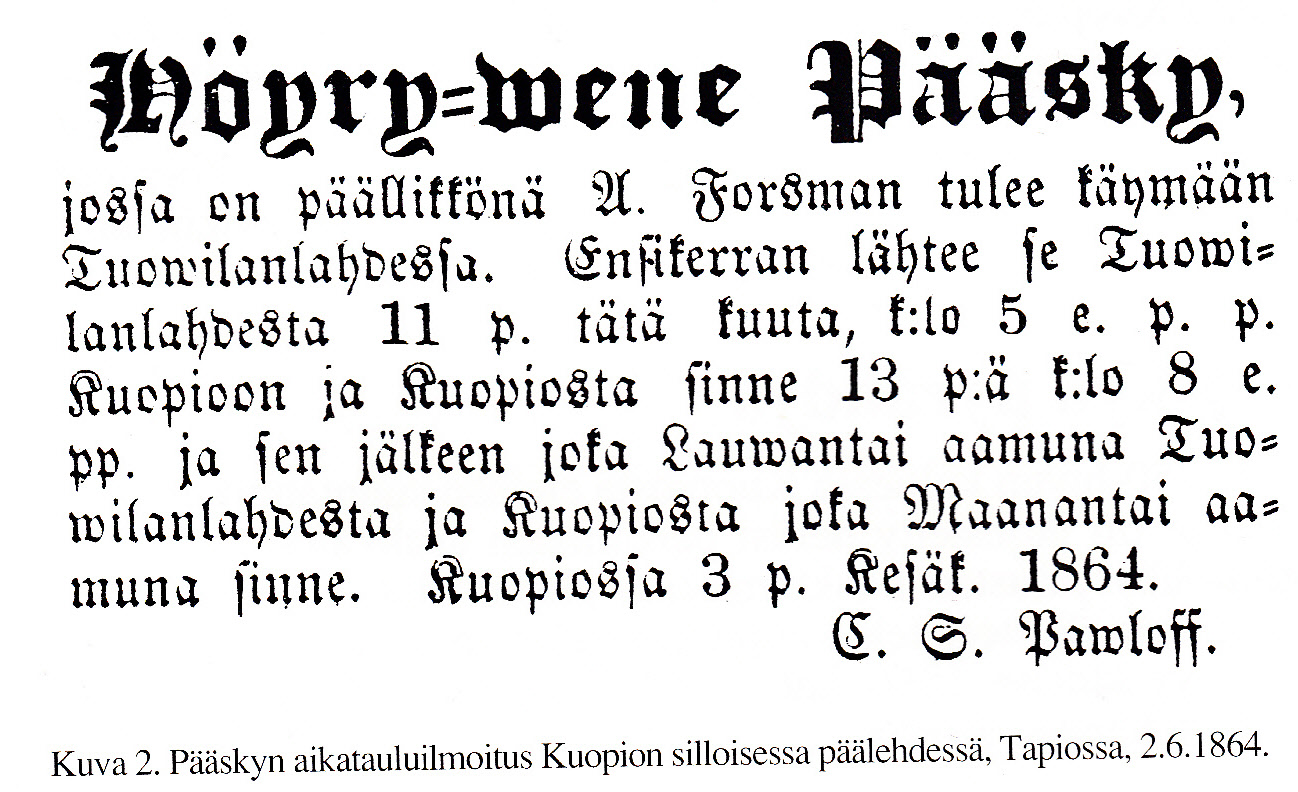
“Seura” dipping “Pääsky’s” wings in Kuopio harbour in 1864
Recently I happened to receive an article that appeared last summer in the newspaper Savo, warmly written by M. Tbgn: “A drowning incident at the Kuopio harbour shore. Summer 1862.” As the matter closely concerns, among others, myself, being the brother of one of the drowned, and as I know well and clearly remember the terrible event in question, I wish to relate it as it met me and my close ones. At the same time I shall correct the lapses of memory of the above‑mentioned writer. It was a beautiful 18th of July 1864 (not 1862). There was a wedding at Savola in Tuovilanlahti. My father, director J. Fredrik Landgren, my mother, my sister Hanna and I travelled there from Pielavesi. When the bridal couple had been wed and the dinner enjoyed, I went, accompanied by a couple of boys, to the pier at Pääsky, located at the far end of Tuovilanlahti, to ask that Pääsky would call at the Savola shore to take on several passengers there who intended to go to Kuopio, and that shortly before departure they would give a long whistle. This was promised by Pääsky’s operator, and so he did. My mother and my sister Hanna were planning to continue their journey to Mikkeli to a relative’s wedding, and therefore they now went to Kuopio on Pääsky. Grammar‑school student Adolf Mehtonen, merchant Petter Qvick and his fiancée Henriikka Tikkanen were also on their way to Kuopio. A large escort accompanied those going on Pääsky down to the shore, where the final farewells were said, good fortune for the journey was wished, and greetings were requested to be conveyed to relatives in Mikkeli. Then hats and handkerchiefs were waved as long as Pääsky could be seen.
At the mouth of Tuovilanlahti, by the shore of Kiukaanniemi, Pääsky stopped to take on firewood. And my sister Hanna, having seen flowers on the shore, stepped onto land one last time to pick them. Then Pääsky called at Maaninka church, where the owner of Halola, Doctor Schmidt, together with his daughter, the wife of organist Lagin of Helsinki’s Nikolai Church, came aboard Pääsky. Without any inkling of what was to come, the journey passed on that beautiful summer evening in that small paddle vessel, which had no other shelter for passengers than a sheet‑metal roof at the stern and curtains of cloth as walls, as protection from wind and rain. Closer to Kuopio, the passengers on Pääsky noticed the tugboat “Seura” coming behind in the same direction. It had towed barges to Suovu and was now being operated by the mate and the engineer. Captain Hellman had this time left the running of the ship to them, remaining himself at merchant Moldakoff’s name‑day celebration.
For the Suovu trip, Seura had been stocked with plenty of intoxicating drink and also drinking companions. The crew of Seura had threatened to “dip Pääsky’s wings.” Between Kelloniemi and the town, those on Pääsky noticed that Seura deviated from the usual route, making a bend to the south. Then it turned to run at full speed past the pier and drove straight towards the side of Pääsky, which was right next to the pier, so close that grammar‑school student A. Mehtonen jumped from its bow onto the pier. Pääsky immediately sank beneath the water, taking with it into the depths those passengers who did not manage to get out from under its sheet‑metal roof. Thus Doctor Schmidt, Mrs. Director Lagi and my sister Hanna were driven under the water. The fourth who lost their life was glass‑cutter Pitkänen’s child, who had been lying on the bench at the very spot where Seura’s bow struck. As Mrs. Lagi was on her way to Kuopio precisely for childbirth, it can be said that five lives fell victim to that deliberate atrocity. There was no race between Pääsky and Seura, nor could there have been any question of such. Everyone who had been on Pääsky knew that.
Seura was a large, strong, fast‑moving tugboat, and Pääsky a small, weak, slow‑moving vessel. Those cursed intoxicating drinks, which countless times have turned a human being into a beast and caused an immeasurable amount of misfortune and sorrow, they too now caused this first collision of steamships on the inland waters of Finland, and countless similar ones thereafter. The cruelty, the bestiality here lay in the fact that if Seura’s operators had, as was said, some hostility towards